

Profile Spotlight | Jay Seidel
By Jasmine Gutierrez
Jay Seidel is a full-time professor and Director of Fullerton College’s Drone Lab. He has revolutionized drone instruction in the West, focusing the lab on pilot certifications for students, engineering novel operations, and applying principles learned from the classroom into different fields—such as marine biology, archaeology, urban planning and search and rescue.
What once began as a lone-course lab has now turned into a four-year curriculum, offering a total of 37 classes. The program currently offers two associate’s degrees and four certificates, with seven more certificates set to be introduced into the program during Fall 2026. The specializations range from environmental research, piloting, business, and various technician disciplines. In addition, Seidel created the nation’s first registered pilot apprenticeship and the West Coast’s first drone-related bachelor’s degree.
Seidel is also a proud Army veteran. He was a combat engineer for four years and a photojournalist for eight years. From serving in Operation Desert Storm to building up a first-of-its-kind drone program in the West Coast, his story is one of perseverance. Seidel was once an eight-year-old dreaming of going to the Air Force. After missing a congressional nomination, Seidel did not get to revisit his former aviation passion until ten years ago. In 2016, he found himself at a higher education drone training in Oregon. In 2017, he found himself being encouraged by his former dean and president to start the drone program.
Now, Seidel’s lab is regionally and nationally recognized as unparalleled, forging new pathways for today’s Fullerton College drone students.
Q&A
In a multi-modal media landscape, how do drones add to the impact that visual storytelling may offer an audience?
Drones give a different perspective of visual storytelling. For example: California, we deal with wildfires. You’re on the ground telling the story. You interview a person who says they lost their house, and they talk about the size of the fire. We can put up a drone and show the magnitude of that scene. When it was just an acreage number, now it’s, “Those are neighborhoods, blocks that are just now gone. Wow, that’s devastating.”
It gives you the potential to give a more complete picture when it comes to storytelling. I was introduced to that in Oregon at my initial [drone] training and was just like, “Wow, the potential for this is amazing.” It gives you scope that you can’t get on the ground with a handheld camera.
“Not every story dictates the need for a drone, but now the drone is like another camera in your camera bag. It just gives you the opportunity to provide a greater perspective and provide a different angle of scope to whatever story you’re presenting if you need it.”
As a Certified Master Thermographer, can you speak to how thermal imaging intersects with drones, and how this may improve one’s visual storytelling or journalistic goal?
Depending on the type of thermal camera you have, you can look at gas leaks, damage on rooftops, search and rescue. There are all kinds of different applications for thermal. A college in Arkansas did a project on monitoring cattle and disease. They could identify that the cattle were sick by how hot their feet were and isolate the sick cattle from the regular cattle. You can use visual storytelling for data stories.
One of the other things for drones is the 3D modeling of photogrammetry projects. We teach students how to map, grab that data and use that information. That could be used in a multimedia story for the public to understand an environmental kind of story that talks about runoff, floodplains, or the impact of erosion. If you’re trying to have this larger concept that you’re trying to convey to people, it’s easier for people to see it visually. Drones can capture that data that can then be stitched together and, through software, presented in a way that people can use for enhanced storytelling.
In your 12 years of military service, you worked as an Army Combat Engineer at Fort Bragg, NC for 4 years and as a Photojournalist in the California Army National Guard at Los Alamitos, CA for 8 years. What urged you to reclass as a photojournalist?
Since I was studying photojournalism in school, I thought it would be great to bring two worlds togethers. I was already almost four years into the Combat Engineer job, and that’s in-the-dirt stuff. It was like: “Oh, wait, you mean I can be a photojournalist and just go into my air-conditioned office? Yeah, I’ll do that.” I think back and I don’t regret that job, I loved every minute of it. Not while I was in it – but now looking back, I loved every minute. I was going to school for photojournalism and had visions of getting into media.
For the National Guard, there are people working skilled, complementary trade jobs. I thought, “Well, I’m trying to get into photojournalism, but I’m over here working on construction and demolition projects, and I don’t think those two are maximizing each other.” I just moved to where I wanted to be and got the experience that I was already learning on the civilian side.
What stories were you able to capture in a unique journalistic environment like the Army?
I covered a lot of the engineering units up and down the state. When stationed at Fort Bragg, I was in an airborne unit. I was also in [Operation] Desert Storm, so I had combat experience. I got to talk to the frontline, special forces unit for the National Guard. I did a lot of great stories in the state with regards to what the engineers were doing. At the time, there was a lot of flooding and natural disasters happening in northern California. The engineers went out to help, and I got to tell their stories – their challenges and what their experiences were like on a day-to-day basis.
I also did fun stories to highlight different things about the National Guard. The Marines at Camp Pendleton do an annual training/mock war scenario, and they need an opposition force. Their opposition force was the California Army National Guard [part-time service members]. It was us from the National Guard, and it was cool because as the opposition, the Marines were supposed to go over us. But the National Guard held them off, which surprised them. Then we made that a story, writing “The National Guard successfully holds off the active-duty Marines.” We also did some PR related outreach. We trained soldiers who were designated public affairs representatives on talking to the media. It was a mixed bag of fun, big picture stuff of the military operation.
How did your time as an Army Photojournalist, even as a Combat Engineer, uniquely shape your current career as a drone professional?
Two things.
One: on active duty, we always heard the phrase “The situation will dictate what you do and what your actions are.” You have to be flexible and adjust to different things. If there’s a roadblock for a project I’m trying to do, I think, “Let’s figure out a different way.” That’s something I think helped me throughout life, and also in what I’m doing with the drone program.
The other thing: from a journalistic side of things, because journalism trains you to be a jack-of-all-trades, expert-at-none where you have to know enough about many things, I think that helped me forge this new frontier of where I could go. Even though my background is journalism, I can start talking about photogrammetric scanning for environmental purposes – I know enough to move that way, and I know where I can get resources. As a trained journalist, I think that really helps.
You mentioned that your passion for aviation is something you’ve carried since a teenager. Can you speak to what sparked your early interest in aviation, especially drones?
My third-grade best friend’s family was from the Air Force, and that triggered me to want to go into the Air Force. From third grade to my senior year in high school, my only purpose was going to the Air Force Academy, becoming a pilot, and then fly 747s for United or something. That was my goal, and that was it. I was raised by my single mom at the time, and she tried her best, and we didn’t know what we didn’t know. I didn’t get the congressional nomination to go to the Academy, and I was devastated.
So, I went to Cal State Fullerton right out of high school, and because I was so focused on the Academy, I had scholarships. After the first semester, I got my first Fs, plural, and lost my scholarships. Now it was like, “I don’t know what I’m going to do, my mom can’t afford this.” Then I ran into an Army recruiter in a parking, and he said to me? “You qualify.”
I thought: “Wow, I can do two years and get money for school.” I can do this.
For aspiring visual storytellers interested in drones, what skills should young professionals seek out?
The biggest thing is to learn the drone: get your license and get your FAA certification so you can work commercially. That’s the hurdle. Once you have that, practice and get used to the capabilities, settings, and what your drone can see and do. It goes back to what I said at the beginning: the situation will dictate. Not every story dictates the need for a drone, but now the drone is like another camera in your camera bag. It just gives you the opportunity to provide a greater perspective and provide a different angle of scope to whatever story you’re presenting if you need it.
Author Bio
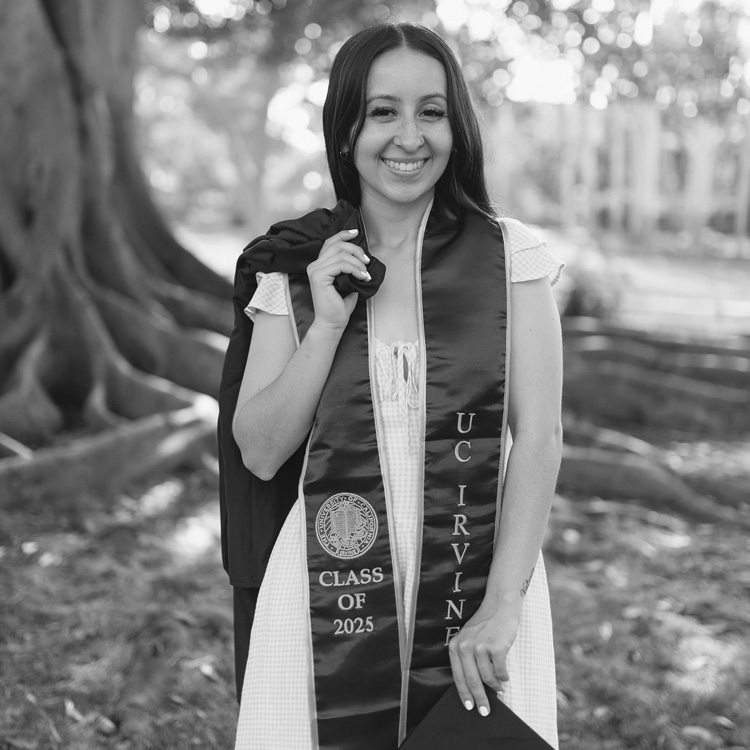
Jasmine Gutierrez graduated cum laude from the University of California, Irvine with a degree in Public Health Policy and an honors emphasis, earning induction into three academic honor societies, including the prestigious Phi Beta Kappa. During her senior year, she served as a fellow with OC World, building portfolios, conducting interviews, and producing content for the OC World Media Club website, and now supports the organization professionally in research, social media, and content development.
Profile Spotlight | Jay Seidel
By Jasmine Gutierrez
Jay Seidel is a full-time professor and Director of Fullerton College’s Drone Lab. He has revolutionized drone instruction in the West, focusing the lab on pilot certifications for students, engineering novel operations, and applying principles learned from the classroom into different fields—such as marine biology, archaeology, urban planning and search and rescue.
What once began as a lone-course lab has now turned into a four-year curriculum, offering a total of 37 classes. The program currently offers two associate’s degrees and four certificates, with seven more certificates set to be introduced into the program during Fall 2026. The specializations range from environmental research, piloting, business, and various technician disciplines. In addition, Seidel created the nation’s first registered pilot apprenticeship and the West Coast’s first drone-related bachelor’s degree.
Seidel is also a proud Army veteran. He was a combat engineer for four years and a photojournalist for eight years. From serving in Operation Desert Storm to building up a first-of-its-kind drone program in the West Coast, his story is one of perseverance. Seidel was once an eight-year-old dreaming of going to the Air Force. After missing a congressional nomination, Seidel did not get to revisit his former aviation passion until ten years ago. In 2016, he found himself at a higher education drone training in Oregon. In 2017, he found himself being encouraged by his former dean and president to start the drone program.
Now, Seidel’s lab is regionally and nationally recognized as unparalleled, forging new pathways for today’s Fullerton College drone students.
Q&A
In a multi-modal media landscape, how do drones add to the impact that visual storytelling may offer an audience?
Drones give a different perspective of visual storytelling. For example: California, we deal with wildfires. You’re on the ground telling the story. You interview a person who says they lost their house, and they talk about the size of the fire. We can put up a drone and show the magnitude of that scene. When it was just an acreage number, now it’s, “Those are neighborhoods, blocks that are just now gone. Wow, that’s devastating.”
It gives you the potential to give a more complete picture when it comes to storytelling. I was introduced to that in Oregon at my initial [drone] training and was just like, “Wow, the potential for this is amazing.” It gives you scope that you can’t get on the ground with a handheld camera.
“Not every story dictates the need for a drone, but now the drone is like another camera in your camera bag. It just gives you the opportunity to provide a greater perspective and provide a different angle of scope to whatever story you’re presenting if you need it.”
As a Certified Master Thermographer, can you speak to how thermal imaging intersects with drones, and how this may improve one’s visual storytelling or journalistic goal?
Depending on the type of thermal camera you have, you can look at gas leaks, damage on rooftops, search and rescue. There are all kinds of different applications for thermal. A college in Arkansas did a project on monitoring cattle and disease. They could identify that the cattle were sick by how hot their feet were and isolate the sick cattle from the regular cattle. You can use visual storytelling for data stories.
One of the other things for drones is the 3D modeling of photogrammetry projects. We teach students how to map, grab that data and use that information. That could be used in a multimedia story for the public to understand an environmental kind of story that talks about runoff, floodplains, or the impact of erosion. If you’re trying to have this larger concept that you’re trying to convey to people, it’s easier for people to see it visually. Drones can capture that data that can then be stitched together and, through software, presented in a way that people can use for enhanced storytelling.
In your 12 years of military service, you worked as an Army Combat Engineer at Fort Bragg, NC for 4 years and as a Photojournalist in the California Army National Guard at Los Alamitos, CA for 8 years. What urged you to reclass as a photojournalist?
Since I was studying photojournalism in school, I thought it would be great to bring two worlds togethers. I was already almost four years into the Combat Engineer job, and that’s in-the-dirt stuff. It was like: “Oh, wait, you mean I can be a photojournalist and just go into my air-conditioned office? Yeah, I’ll do that.” I think back and I don’t regret that job, I loved every minute of it. Not while I was in it – but now looking back, I loved every minute. I was going to school for photojournalism and had visions of getting into media.
For the National Guard, there are people working skilled, complementary trade jobs. I thought, “Well, I’m trying to get into photojournalism, but I’m over here working on construction and demolition projects, and I don’t think those two are maximizing each other.” I just moved to where I wanted to be and got the experience that I was already learning on the civilian side.
What stories were you able to capture in a unique journalistic environment like the Army?
I covered a lot of the engineering units up and down the state. When stationed at Fort Bragg, I was in an airborne unit. I was also in [Operation] Desert Storm, so I had combat experience. I got to talk to the frontline, special forces unit for the National Guard. I did a lot of great stories in the state with regards to what the engineers were doing. At the time, there was a lot of flooding and natural disasters happening in northern California. The engineers went out to help, and I got to tell their stories – their challenges and what their experiences were like on a day-to-day basis.
I also did fun stories to highlight different things about the National Guard. The Marines at Camp Pendleton do an annual training/mock war scenario, and they need an opposition force. Their opposition force was the California Army National Guard [part-time service members]. It was us from the National Guard, and it was cool because as the opposition, the Marines were supposed to go over us. But the National Guard held them off, which surprised them. Then we made that a story, writing “The National Guard successfully holds off the active-duty Marines.” We also did some PR related outreach. We trained soldiers who were designated public affairs representatives on talking to the media. It was a mixed bag of fun, big picture stuff of the military operation.
How did your time as an Army Photojournalist, even as a Combat Engineer, uniquely shape your current career as a drone professional?
Two things.
One: on active duty, we always heard the phrase “The situation will dictate what you do and what your actions are.” You have to be flexible and adjust to different things. If there’s a roadblock for a project I’m trying to do, I think, “Let’s figure out a different way.” That’s something I think helped me throughout life, and also in what I’m doing with the drone program.
The other thing: from a journalistic side of things, because journalism trains you to be a jack-of-all-trades, expert-at-none where you have to know enough about many things, I think that helped me forge this new frontier of where I could go. Even though my background is journalism, I can start talking about photogrammetric scanning for environmental purposes – I know enough to move that way, and I know where I can get resources. As a trained journalist, I think that really helps.
You mentioned that your passion for aviation is something you’ve carried since a teenager. Can you speak to what sparked your early interest in aviation, especially drones?
My third-grade best friend’s family was from the Air Force, and that triggered me to want to go into the Air Force. From third grade to my senior year in high school, my only purpose was going to the Air Force Academy, becoming a pilot, and then fly 747s for United or something. That was my goal, and that was it. I was raised by my single mom at the time, and she tried her best, and we didn’t know what we didn’t know. I didn’t get the congressional nomination to go to the Academy, and I was devastated.
So, I went to Cal State Fullerton right out of high school, and because I was so focused on the Academy, I had scholarships. After the first semester, I got my first Fs, plural, and lost my scholarships. Now it was like, “I don’t know what I’m going to do, my mom can’t afford this.” Then I ran into an Army recruiter in a parking, and he said to me? “You qualify.”
I thought: “Wow, I can do two years and get money for school.” I can do this.
For aspiring visual storytellers interested in drones, what skills should young professionals seek out?
The biggest thing is to learn the drone: get your license and get your FAA certification so you can work commercially. That’s the hurdle. Once you have that, practice and get used to the capabilities, settings, and what your drone can see and do. It goes back to what I said at the beginning: the situation will dictate. Not every story dictates the need for a drone, but now the drone is like another camera in your camera bag. It just gives you the opportunity to provide a greater perspective and provide a different angle of scope to whatever story you’re presenting if you need it.
Author Bio
Jasmine Gutierrez graduated cum laude from the University of California, Irvine with a degree in Public Health Policy and an honors emphasis, earning induction into three academic honor societies, including the prestigious Phi Beta Kappa. During her senior year, she served as a fellow with OC World, building portfolios, conducting interviews, and producing content for the OC World Media Club website, and now supports the organization professionally in research, social media, and content development.


